


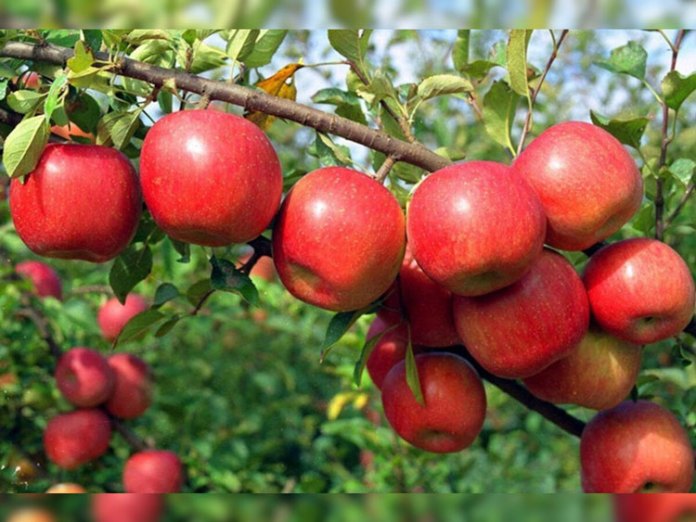
The steep cut in import duty on US apples has left Himachal Pradesh’s growers worried, with many cautioning that lower priced imports from the US could impact the fruit sales.
While the duty has been reduced from 50 per cent to 25 per cent, the minimum import price (MIP) has simultaneously been raised from Rs 50 to Rs 80 per kg.
Under this new structure, US apples are expected to land in India at around Rs 100 per kg, nearly the same price that premium domestic varieties command.
“At this price, the US apple will pose huge competition to our produce since consumers are likely to shift towards the imported fruit,” said Harish Chauhan, convener, Sanyukt Kisan Manch (SKM).
He challenged the government contention that the US apple was landing in India at Rs 75 per kg prior to this deal, and now it would land at a higher price of Rs 100 per kg. “If the US apple was landing in India at Rs 75 per kg as is being pointed out, how come it is sold at Rs 200-250 per kg in retail,” asked Chauhan.
He feared that if the US apple landed at Rs 100 per kg in India, the practice of storing premium apple in CA stores would become unviable.
“Why would any CA store owner buy our premium apple at Rs 85-90 per kg, incur the storage cost for nearly six months, and then bring it to the market at a price higher than the US apple. Who would buy it,” Chauhan asked.
Chauhan is among the growers who feel the US apple at this price will have a devastating impact on the local apple economy.
Lokinder Bisht, president, Progressive Growers Association (PGA), feels the premium quality apple will be hit, but the Rs 80 MIP and 25 per cent tariff will limit the damage to the local apple economy to some extent.
“The MIP should have been at least Rs 100 to offer more protection to the local growers,” he said.
The PGA is one of the largest apple growers’ bodies in the state. Bisht said the local premium apple would not get a higher price than the US apple.
“If the price of our premium apple goes down, the impact will be felt on the lower-quality apple as well,” said Bisht, adding that there must be restrictions on the amount of apple that could be bought with reduced tariff. “Unlimited imports will pose a big threat to the economy,” he said.
Meanwhile, some growers feel the deal will have little impact on the local apple economy. Dimple Panjta, president of the Himalayan Society for Horticulture and Agriculture Development, says the local premium apple is good enough to compete with any foreign import.
“We can’t run away from global competition forever. We should see this as an opportunity to improve our quality. Instead of demanding protection, we should seek subsidies and better planting material from the government to help us enhance our production and quality,” said Panjta.
Can the local apple growers compete with their US or European counterparts? Most growers say it’s a Herculean challenge, considering the generous subsides the US growers get and their highly mechanised cultivation.
“We lack the government support that is available to our counterparts in the US and New Zealand. Also, barring Kinnaur, we don’t have the exact temperate climate that is best suited for growing apple.
Having said that, we still need to improve our quality, not to compete but to survive,” said Deepak Singha, an apple grower from Kotgarh.